
The Department of Agricultural Sciences at Techno India University offers the undergraduate programme B.Sc. (Hons.) in Agriculture in accordance with the ICAR–NEP 2020 curriculum framework based on the 6th Dean Committee Report. The programme has commenced with a strong cohort of bright students and is supported by well-equipped laboratories, experienced faculty members, and dedicated technical staff. In addition to the core ICAR curriculum, the department provides advanced, smart add-on courses in every semester, including computer programming, drone technology in agriculture, smart farming, remote sensing, Geographic Information Systems (GIS), and applications of AI and Data Science in agriculture. The department also encourages experiential learning by providing students with opportunities to undertake live projects on campus. These include mushroom spawn production and cultivation, bio-pesticide and bio-fertilizer production, vermicompost production, microgreen cultivation, and practices in vertical and integrated farming.
Step 1: Make online Application at http://www.technoindiauniversity.ac.in
Step 2: Complete application form with every detail. Submit your Registered mail- id and mobile number to receive our confirmation
Step 3: Acknowledgement of application through sms and email.
Step 4: Confirmation of appearing in examination will be sent via email or sms after filling up form. A unique application id will be generated. Candidate is required to appear for entrance examination with the id.
Step 5: Final Admission and Registration with payment of requisite fees.
Our current application areas include smart farming with AI using advanced technology like sensors, drones, Data analytics which improve agriculture productivity and efficiency. Artificial intelligence is helping farmers monitor crop health, predict weather conditions, detect pests and diseases early and optimise irrigation and fertilizer use. Tools such as machine learning models and automated system is reducing manual labour and increasing precision. AI also supports decision making by analysing large amount of farm data. Overall smart farming is increases the yield, reduces costs, conserves resources and promotes sustainability making farming more efficient and environmentally friendly in modern era.
Our current application area includes the production and utilisation of very popular oyster mushrooms like Pleurotus sp. And some hybrids in West Bengal which became highly demanding mushrooms which can be cultivated in simple paddy straw as substrate. They are having unique flavour, taste, colour along with nutritional attributes such as high protein and minerals. Apart from these, they are also being commercially cultivated to supply as resources for drug production in the pharmaceutical industry. Mainly they are having medicinal attributes like anti-cancer, anti-microbial, anti-inflammatory properties including lowering cholesterol, sugar level and blood pressure.
Our current application area includes the production and utilisation of Biopesticides from natural resources which offer an eco-friendly alternative to chemical pesticides. Plants like Akondo (Calotropis gigantea) contain toxic milky latics rich in alkaloid, cardiac glycosides and calotropin which deserrupt insect nervous and digestive system acting as natural repellent and deterrents. Neem based products are developed from neem leaf extracts and widely used for pest control. These plant derived substances effectively reduce pest damage while being safe for the environment. The use of such biopesticides promote sustainable agriculture, minimizing chemical residues and supports healthier ecosystem, making them important component of modern environmental farming practices
Our current application area includes the Remote sensing and GIS which plays an important role in modern agriculture by helping farmers to take better decisions. Remote sensing uses satellites to collect data on crop health, soil moisture condition, whether condition etc. (GIS) Geographic information system helps analysing the data for easy understanding. Farmers and researchers use these technologies to monitor crop growth, detect diseases early, manage irrigation and plan land use efficiently. They also help in yield prediction and disaster management. Overall remote sensing and GIS improve productivity, reduce resource wastage and support sustainable and precision agriculture practices.
Our current application area includes the Hitech hydroponics which is a modern application of precision farming where crops are grown without soil using nutrient reach water under control conditions. Advance technology is like sensors, IOT and AI (artificial intelligence) monitor parameters such as Ph, temperature, humidity and nutrient level in real time. These systems automatically adjust irrigation, lighting and nutrient supply to optimise plant growth and reduce waste. Hydroponics ensures higher yield, saves up to 90% of water and other resources. It improves efficiency minimise is human effort and supports sustainability.
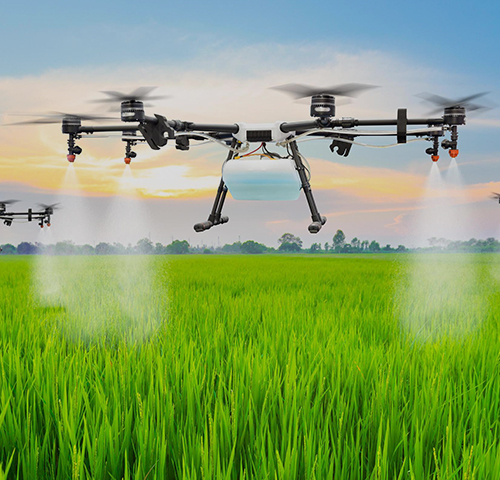
Our current application area includes the Drone technology which is highly used in modern agriculture to improve efficiency and productivity. Drone easily helps in crop monitoring by capturing real time image allowing farmers to assess plant health, detect diseases and identify pest infestations very early. They are also used for precision spraying of fertilizers and pesticides reducing chemical use and labour cost. Drone assist in irrigation management by identifying dry areas in fields. Additionally they support mapping and surveying the land in a building better planning and decision making. Overall drone technology enhances precision farming, saves time -resources and promotes sustainable agriculture practices.